


VEDC 2025: Vietnamese Students’ Electronic Products Move Closer to the Market
Ten electronic products reaching the final round of the Vietnam Electronic Design Competition 2025 (VEDC 2025) have demonstrated market-oriented quality, with solutions ranging from biomedical electronics to traffic safety systems showing strong potential for immediate real-world application.
On the morning of December 12, 2025, the Final Round of the Vietnam Electronic Design Competition 2025 (VEDC 2025) officially opened at the Posts and Telecommunications Institute of Technology (PTIT) in Hanoi.
The judging panel of the first Vietnam Electronic Design Competition in 2025 evaluated that all ten finalist teams presented outstanding products with a high level of completion and very competitive quality.
Dr. Nguyen Trung Hieu, Head of the Faculty of Electronic Engineering 1 at PTIT and representative of the Organizing Committee, said that the regional semi-final rounds held across the country were successfully organized. Judges from each round agreed that if more teams had been allowed to enter the final stage, it would have been even better because the talent pool among Vietnamese students remains very abundant.
Dr. Nguyen Trung Hieu further explained that from the beginning of the competition, the organizers clearly defined the goal of creating a valuable platform where students could showcase their creative ideas and transform those ideas into practical products based on foundational electronic engineering technologies and IoT solutions.
He also acknowledged that the journey from proving the feasibility of an idea to bringing a product to the commercial market is still relatively long. However, the products developed by students in this competition have clearly demonstrated the potential to become commercially viable solutions.
Diverse fields with strong practical potential
The ten finalist teams this year brought significant diversity in terms of application areas. Student-developed products covered a wide range of fields, including telecommunications systems, biomedical electronic devices for healthcare, technology solutions for rescue and emergency response, as well as traffic safety and medical monitoring systems.
Mr. Nguyen Huy Nhan, representative of Viettel Software, a partner supporting the competition, highly appreciated the professional quality of the participating teams. He noted that in terms of electronic circuit design and technical implementation, these products have reached a level close to commercial products currently available on the market.
According to Mr. Nhan, with additional investment in expert knowledge, financial resources, and infrastructure, these solutions could potentially be developed into market-ready products for consumers.
He stated:
“Viettel Group and its member companies are highly interested in innovative electronic products, especially those capable of being applied in real life. Our priority is to use these products to serve domestic needs first. If the products achieve high quality, we always aim to bring them to international markets, helping affirm Vietnam’s position and manufacturing capabilities globally.”
VKU students confident in commercializing their product
Student Nguyen Dinh Truong, a member of the ADL IoT team from the Vietnam-Korea University of Information and Communication Technology (VKU), University of Danang, shared:
“I have learned many new things from building IoT systems and integrating artificial intelligence technologies into our practical product. Our project is a connected network system supporting smart protective equipment for workers in construction environments.”
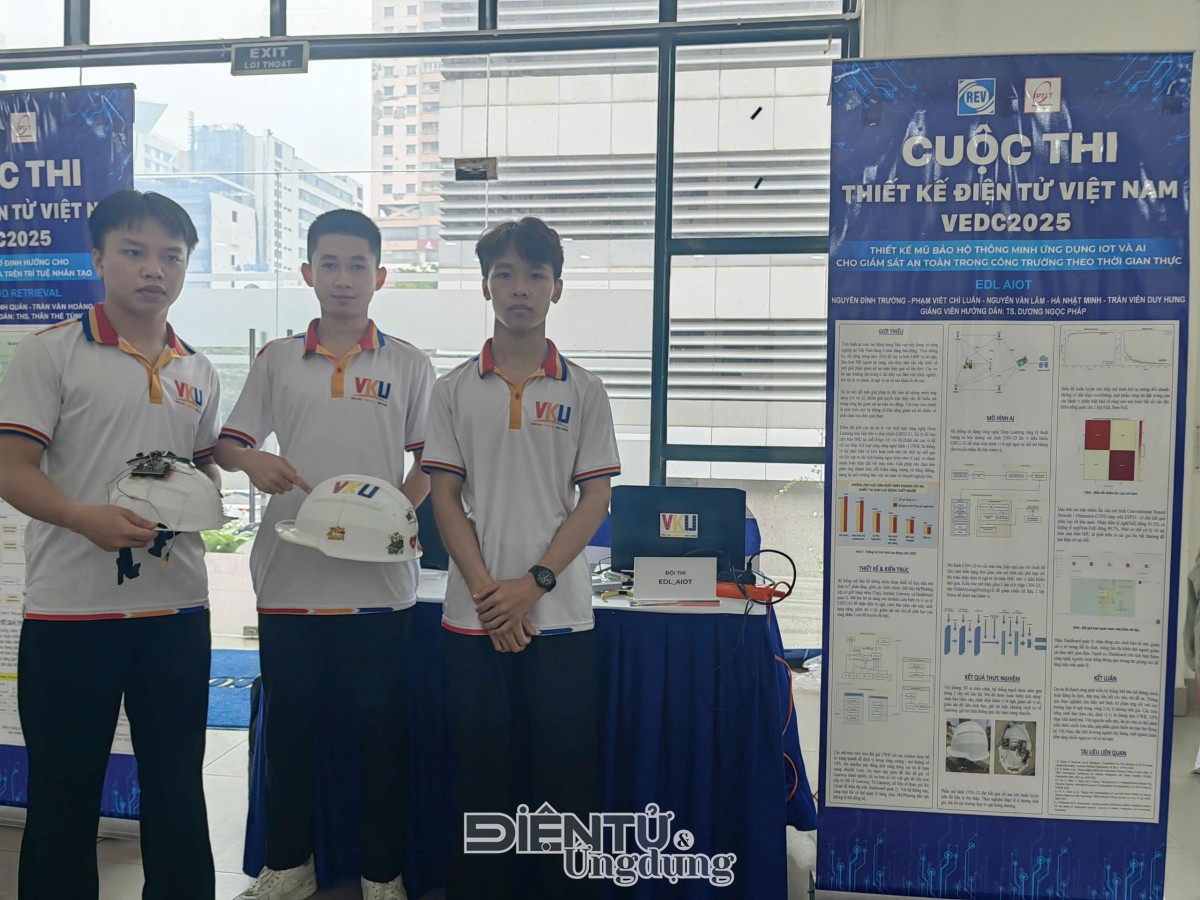
When given the opportunity to participate in the final round, Nguyen Dinh Truong confidently stated that his team’s product had the capability to achieve a high ranking in the competition.
Universities highly value student innovation movements
Dr. Tran The Son, Vice President of the Vietnam-Korea University of Information and Communication Technology, said that the Vietnam Electronic Design Competition has significant importance in the current context, as the Vietnamese Government is focusing strongly on developing domestic technology capabilities and designing locally developed technology products.
The university highly appreciated the importance of the competition and actively encouraged students to participate.
Dr. Tran The Son said that nearly ten student teams from the university registered for the initial qualifying round. Among them, two teams advanced to the semi-final round and one team reached the final round.
He also emphasized that students showed great enthusiasm throughout the competition. From a technical perspective, students demonstrated their ability to apply both theoretical knowledge and practical skills.
A particularly important aspect of this competition was the application of artificial intelligence technology in designing and implementing IoT electronic systems to solve real social challenges.
He stressed that mastering core technologies is extremely important for Vietnam’s future development. Competitions such as the Vietnam Electronic Design Competition provide strong motivation for students to develop passion, creativity, and responsibility in contributing to national technological independence.
Businesses supporting young technology talent development
Mr. Nguyen Huy Nhan from Viettel Software said that Viettel’s participation in the competition was not only about evaluating student products but also about nurturing and developing young technology talent.
Students do not necessarily have to work for Viettel after graduation; they can choose different career paths and contribute to the overall development of Vietnam’s electronics industry.
Participants demonstrated comprehensive capabilities, from generating initial ideas, continuously updating knowledge, implementing projects, and organizing teamwork effectively.
These are exactly the qualities universities hope to see in more student groups in the future.
The cooperation and support from enterprises have created valuable opportunities for students to access real-world market environments while still studying.
The electronic products developed by Vietnamese students at the Vietnam Electronic Design Competition have demonstrated that they can compete with industrial products currently available on the market, provided that additional investment in human resources and finance is available to complete and scale them.