


VEDC 2026 Draws 270 Teams from 61 Institutions, Over 1,000 Students Take Part
The competition recorded 270 competing teams from 61 universities, academies, colleges and research institutes nationwide, with 1,017 students directly involved in building their entries
The Vietnam Electronic Design Competition 2026 (VEDC 2026) has officially closed its one-month registration period, running from June 1 to June 30, 2026. The competition recorded 270 competing teams from 61 universities, academies, colleges and research institutes nationwide, with 1,017 students directly involved in building their entries. The number of registered teams doubled compared with the competition's first season, establishing VEDC 2026 as one of the largest academic playgrounds in electronics, artificial intelligence (AI), the Internet of Things (IoT), embedded systems and hardware design for engineering students across the country.
The competition is presided over by the Radio-Electronics Association of Vietnam, with the Vietnam-Korea University of Information and Communication Technology (VKU), University of Danang, serving as host institution, in coordination with the Military Technical Academy (MTA) and the University of Science (HCMUS), Vietnam National University Ho Chi Minh City. The three co-organizing institutions share a common goal of building a credible academic playground that encourages students to research, innovate and develop electronic products with real-world applicability, while strengthening ties between universities, businesses and research organizations in the electronics and semiconductor sector.
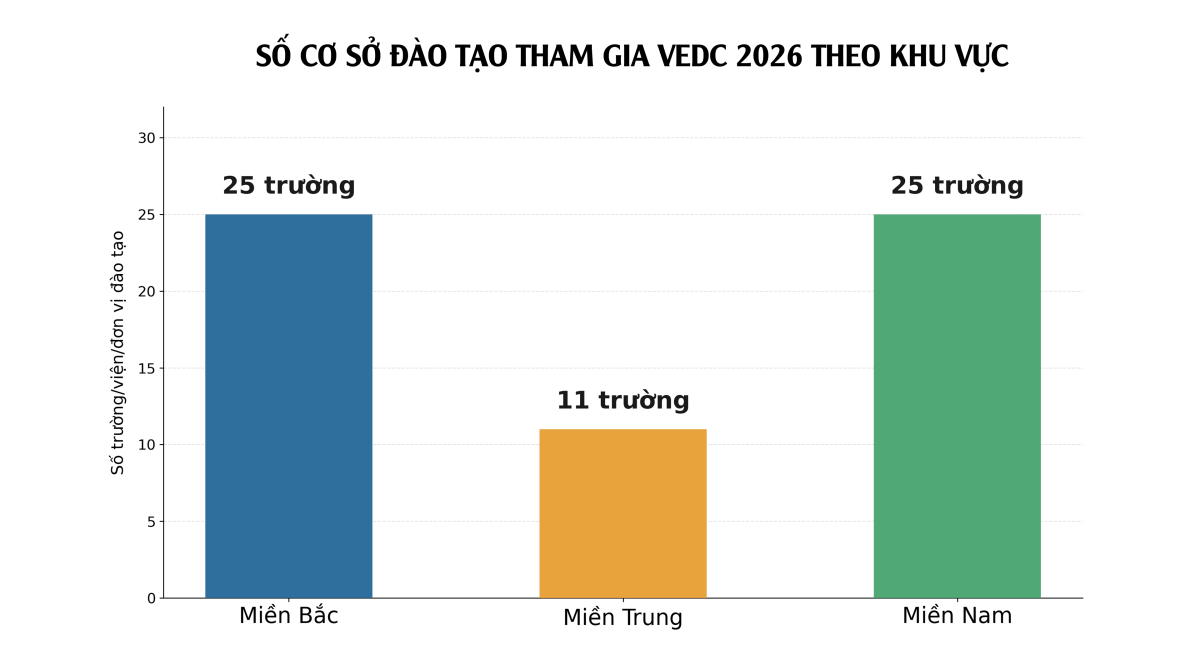
By competing region, the northern region contributed 114 teams, the southern region contributed 96 teams and the central region contributed 60 teams. A number of leading technical training institutions registered large numbers of teams. The University of Science, Vietnam National University Ho Chi Minh City, and the University of Science and Technology, University of Danang, jointly led with 26 teams each. The School of Electrical and Electronic Engineering at Hanoi University of Industry contributed 18 teams, the Posts and Telecommunications Institute of Technology contributed 14 teams, host institution VKU contributed 13 teams, and the University of Information and Communication Technology, Thai Nguyen University, contributed 10 teams. Other familiar names in the technical and engineering field, including Hanoi University of Science and Technology, the Military Technical Academy, Phenikaa University, Duy Tan University, Can Tho University, FPT University and VinUniversity, also submitted teams to the competition.
A new feature of this year's season is that all 270 teams developed their products around a single shared theme, "Embedded AI for Smart IoT Systems." The organizing committee encouraged students to apply modern technologies such as Edge AI, TinyML, AI Vision, FPGA and integrated-circuit design, deployed on common hardware platforms including the ESP32, STM32, Raspberry Pi and Jetson Nano. Teams were required to complete their products from the idea stage through hardware design, software programming and AI integration, all the way to testing and real-world deployment.
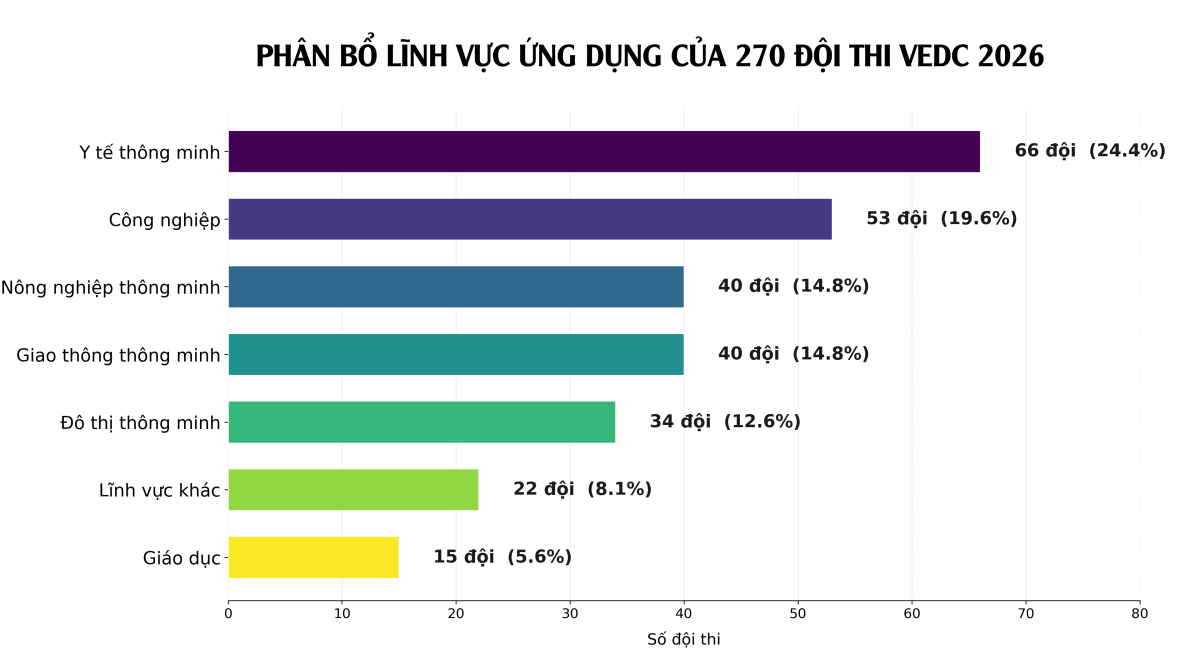
By application field, smart healthcare accounted for the highest share at 24.4 percent of teams, followed by industry at 19.6 percent, smart agriculture and smart transportation tied at 14.8 percent each, smart urban development at 13 percent, education at 5.6 percent, and other fields at 7.8 percent. These results point to a growing interest among students in technologies that serve digital transformation and sustainable development.
Following the close of the qualifying round, the VEDC 2026 judging panel will evaluate competition entries across the northern, central and southern regions to select the 30 strongest teams to advance to the semifinal round, expected to take place from October 19 to 24, 2026. From those 30 semifinalist teams, the organizing committee will then select 10 outstanding teams to compete in the national final, expected to be held on November 25, 2026, at the Vietnam-Korea University of Information and Communication Technology, University of Danang.
The organizing committee said that attracting more than 1,000 students as early as the competition's second season continues to affirm the credibility and appeal of VEDC 2026 within the national community of engineering students. Amid Vietnam's ongoing implementation of Resolution No. 57-NQ/TW on science, technology, innovation and national digital transformation, VEDC is expected to become an annual electronic design competition of national scale, contributing to the discovery and development of high-quality human resources for the fields of electronics, artificial intelligence, the Internet of Things, embedded systems and semiconductors.
About the Vietnam Electronic Design Competition (VEDC) VEDC is an annual academic competition for students from universities, academies, colleges and research institutes nationwide, presided over by the Radio-Electronics Association of Vietnam. The competition receives professional sponsorship from the Ministry of Science and Technology, the Ministry of Agriculture and Environment, and the National Innovation Center (NIC). VEDC aims to promote research, design and development of electronic products with practical applicability, while strengthening connections between universities, businesses and research organizations within Vietnam's innovation ecosystem for electronics, AI, IoT, embedded systems and semiconductors. Competition website: www.revedc.vn |